Leap Second Lenny
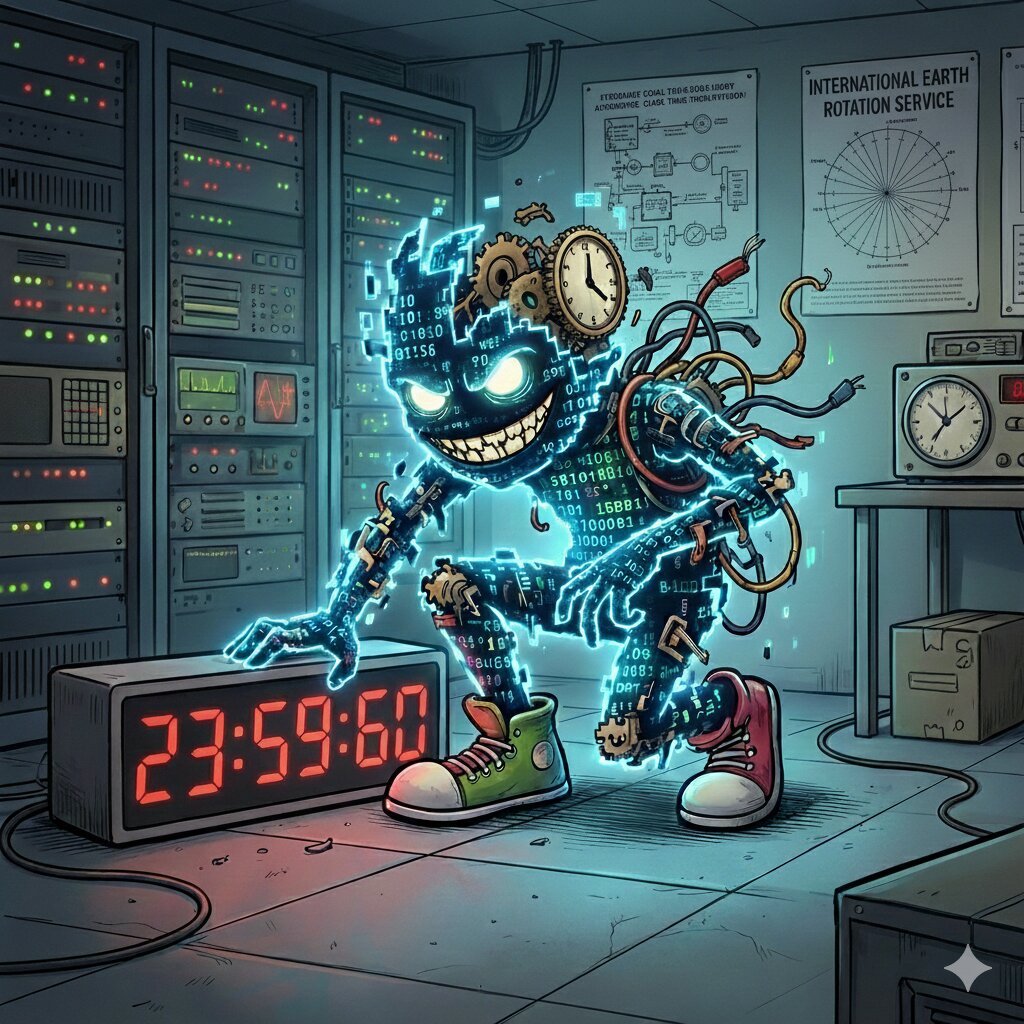
Image: Nano Banana
Timekeeping systems are...strange. Let's take a deeper dive into the messy accounting problems that leap days and leap seconds attempt to solve.
The Fundamentals
Atomic Second
The fundamental unit. Defined as exactly 9,192,631,770 oscillations of a Cesium-133 atom. It never changes.
Atomic Day
Exactly 86,400 atomic seconds (24 hours × 60 min × 60 sec). This is what our computers and watches count.
Solar Day
The time it takes Earth to spin once so the Sun appears in the same place. It varies slightly but averages ~86,400.002 atomic seconds.
Tropical Year
The time for one full orbit around the Sun. It equals roughly 365.2422 atomic days.
1. The Orbit (Leap Years)
The Earth's revolution around the Sun takes approximately 365.2422 days. This is a consistent, predictable pattern caused by gravity. We solve the mismatch by adding a fixed day (Feb 29) every 4 years.
Actual Orbit: ~365.2422 Days
Why This Matters
Without leap years, our calendar would drift by about 6 hours every year. After 100 years, the calendar would be off by 25 days. Eventually, the Northern Hemisphere would be celebrating Christmas in the middle of summer.
Folklore: Leap Day William
“Real life is for March!”
According to legend, a gilled entity named Leap Day William emerges from the Mariana Trench every 4 years. He wears blue and yellow and trades candy for children's tears. Remember to wear blue or he'll poke you in the eye!
✓Why This Works: Predictable Orbits
Earth's orbit around the Sun is governed by gravity—a stable, predictable force. The orbital period is constant at ~365.2422 days, which means we can calculate leap years for millennia into the future with perfect accuracy. The pattern is simple: add a day every 4 years, skip century years unless they're divisible by 400.
2. The Spin (Leap Seconds)
The Earth's rotation on its own axis determines the length of a day. Unlike the orbit, the spin is chaotic—influenced by magma currents, tides, and weather. We cannot predict it far in advance.(Fun Fact: The last leap second was added on December 31, 2016. As of 2025, Earth's rotation has actually sped up slightly, so we haven't needed one in years!)
Why This Matters
Without leap seconds, the gap between atomic time (clocks) and solar time (sun) would grow. It is a slow drift (~1 min every 50 years), but eventually, noon on the clock would drift away from solar noon.
Folklore: Leap Second Lenny
“Mind the gap.”
A glitch-gremlin made of discarded milliseconds who lives in the buffer overflow of atomic clocks. When a positive leap second occurs (23:59:60), Lenny pauses time to tie his shoes; if you aren't wearing a watch, he steals a second of your life. During a negative leap second, he walks backward through server rooms, devouring data to make the clock skip a beat.
The Data: Why Leap Seconds Are Chaotic
Unlike leap years, which follow a predictable pattern based on Earth's orbit, leap seconds are chaotic because Earth's rotation is influenced by unpredictable factors like magma currents, ocean tides, and atmospheric conditions.
Since the concept was introduced in 1972, there have been exactly 27 leap seconds—all positive (adding a second). We've never needed a negative leap second, though Earth's recent speed-up makes it theoretically possible before the 2035 deadline.
The Market: What Happens Next?
In 2022, the world's timekeeping authorities voted to abolish the leap second by 2035 (presumably because the nightmare to implement it on worldwide computer systems outweighted the minor benefit). They decided that they will just let atomic time drift away from aligning with earth's rotation, and "figure out a better solution later." Classic scientists. But before that deadline, will we see any more leap seconds? And if so, will we finally witness the first-ever negative leap second?
Place your bets:
🎰Leap Second Prediction Market (2025-2035)
The authorities voted to abolish the leap second by 2035. You have just enough credits for ONE bet.(Choose wisely. There are no refunds in physics.)
Contract Terms
Pays YES if at least one negative leap second is officially declared before 2035.
Contract Terms
Pays YES only if absolutely zero leap seconds (positive OR negative) occur before 2035.
Contract Terms
Pays YES if at least one positive leap second is officially declared before 2035.